
Davenport Previous-Resident Time Layers
Davenport sources begin at different dates and prove different things. Modern parcel and permit data establish a present reference. Directories and census schedules suggest occupants. Deeds document conveyances, while maps describe a structure at one moment. Choose the era first and keep the source date with every name.
| Source | Years It Covers | Where Held | What It Shows |
|---|---|---|---|
| Recorder deeds and land books | Archival series 1838–1910; guide lists indexes 1839–1890 | Recorder, DPL, State Historical Society | Parties, conveyance and legal description |
| Davenport city directories | 1855 or 1856 to present | Richardson-Sloane and FamilySearch | Printed address and household clues |
| Federal census | Released schedules through 1950 | NARA, FamilySearch, library access | Household and relationship fields |
| Sanborn maps | 1886, 1892, 1910 and 1956 material | DPL and Library of Congress | Footprint, stories and materials |
| Building permits | City description from 1919; viewer split in 2020 | Davenport Building Division | Work, parcel, dates and inspections |
| Tax books | 1849–1970 in the house guide | DPL, archives and county | Value changes and continuity clues |
The AVA online start date is not published. When the web index stops, contact the Recorder, use transfer books, or consult Davenport Public Library and the State Historical Society finding aid.
Oakdale burial images extend from 1856 to 1989, and the DPL probate index spans 1838 to 1962 with older packet holdings through 1947. Those sources do not replace a deed or directory. They help explain why a name stops appearing, identify relatives, and point toward an estate file. Keep access limits in the timeline so a blank year is not mistaken for an empty house.
Reverse a Scott County Deed Chain
Begin with Beacon parcel access and copy the site address, parcel number, owner, and legal description. Then open the Scott County AVA index. AVA supports party names, date ranges, document number and type, subdivision, municipality, tract, parcel or address, and book/page searches.
- Find the current owner's likely purchase deed and compare the legal description, not just the street number.
- Record seller, buyer, document number, type, date, and legal text.
- Search the seller as a buyer in an earlier period to locate the prior purchase.
- Repeat while the legal description remains consistent, watching for parcel splits, easements, and plats.
- Request official copies or older books at the Recorder counter when AVA stops.
- Grantor and grantee
- The grantor transfers an interest; the grantee receives it.
- Chain of title
- The sequence of recorded transfers affecting the same land.
- Legal description
- Lot, block, addition, or survey language that identifies land more reliably than a changeable street address.
AVA is a finding index, not the official copy. A document may already have an official number while it waits for indexing, verification, or public release. Save the search terms and ask the Scott County Recorder at 600 W. 4th Street when a recent transfer seems absent. The counter also handles older books and copies that cannot be obtained through the public interface.
Match Davenport Households by Year
Richardson-Sloane reports directories from 1855 to the present, while its house guide says 1856. The 1890–91 volume adds a heads-of-households and businesses section by street address. Begin at the nearest known year, read the address section, then confirm each name in the alphabetical entry.
Compare at least three volumes and pair the nearest released census year for household relationships. The complete shelf is described on the Davenport city directory page. Newspapers, probate files, churches, and cemeteries can then explain a death, move, marriage, or estate.
- Choose a directory near a known deed, permit, census, or family event.
- Capture the printed address, names, abbreviations, page, and year.
- Check the volume before and after it to bracket change.
- Compare a released census, preserving its enumeration date.
- Confirm the outcome in a second local source.
Lawful use. Davenport house-history records support genealogy and personal research. Never use them to stalk, track, harass, threaten, or harm a living person.
Directory abbreviations need care. A spouse name, occupation, widow marker, business address, or “removed” note can separate two similar households. Census enumeration dates rarely match directory publication dates, so a mismatch may record a move rather than an error. Write the dates beside both entries and use an obituary, deed, tax book, or permit to explain the transition.
Explain Davenport Building Changes
Some past residents disappear because the structure changed. Davenport permits can show a parcel, owner or mailing party, class of work, project cost, dates, notes, and inspections. The city describes permit history from 1919 and a current/historical viewer split at March 1, 2020. It is not a full inventory of every alteration or use.
Sanborn maps add snapshots from 1886, 1892, 1910, and later 1956 material. They show footprints, materials, stories, outbuildings, and nearby features. Tax values from 1849–1970 may flag a period of change, but neither a tax jump nor a map identifies every occupant.
Record the Sanborn sheet number, map date, street intersection, and any pasted revision. A structure may be renumbered, replaced, split, or shown under a business use. Permit examples in the research show that demolition and emergency events can account for a building's sudden disappearance. Compare the permit parcel to the current legal description before linking the event to earlier residents.
Davenport Archives Fill Early Gaps
The State Historical Society Scott County inventory bridges current portals and older books. Its series cover Recorder land material, Auditor tax and transfer records, Clerk judgments, naturalizations and probate, plus Davenport municipal records. DPL also lists deeds from 1838–1910, a probate index from 1838–1962, and packets from 1838–1947.
See the archival finding aid for early Davenport address research.
The capture points to series descriptions, not instant record images. Check access before travel because renovation affected service through late 2026.
Use the finding aid to name the series and dates in a staff request. The archives route is especially useful for transfer books, tax material, probate, judgments, naturalization, and municipal volumes that have no name-search box. Richardson-Sloane Special Collections remains the best local first contact, and its FamilySearch Affiliate Library status may unlock images that are restricted from a home account.
Confirm Davenport Life Events
Davenport Public Library holds local newspaper runs from 1838 to the present in its collection description, card files and obituary books with gaps, church microfilms, and an abstracted Davenport Democrat & Leader name set for 1896–1946. These records can connect a former address with a spouse, parent, church, cemetery, or estate.
Review Iowa historical vital-record holdings and age thresholds.
The state page can identify an available index or film. An index entry is not a certificate, and protected records still require the proper request route.
Iowa Code section 144.43 opens qualifying birth, marriage, and divorce records at 75 years and death records at 50 years, subject to restricted categories. Scott County and Iowa HHS publish different general cutoff language for local availability. Ask about the exact event and year instead of forcing one chart onto every Davenport family record.
Davenport Cemetery Name Bridges
Burial and lot-owner records can connect previous residents with relatives, a church, or an address. Oakdale records cover interments from 1856–1989 in the cited collection, and a 1906 lot-owner volume supplies a less obvious bridge. Pair cemetery evidence with an obituary, directory, probate record, or vital index.
Open the Scott County cemetery index information.
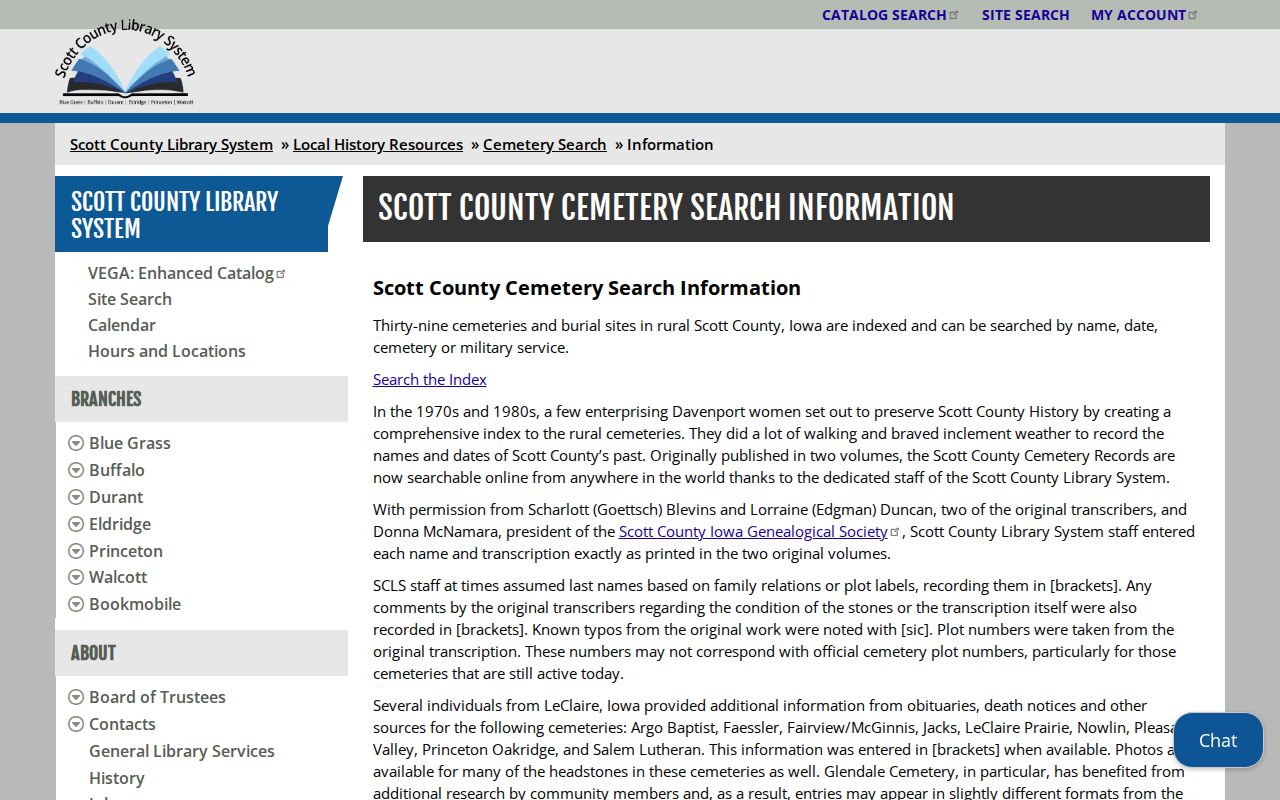
The county route covers its indexed cemetery material; it is not a full register for every burial tied to Davenport.
Oakdale and Pine Hill publish direct contact routes, although neither supplied a complete current online roster in the research. Ask the cemetery office for the lot, section, burial date, and exact spelling it holds. A 1906 Oakdale lot-owner volume can connect a surname with a family plot even when the relevant certificate is still restricted.
Davenport Records Outlast Courthouses
Scott County's first district court met at St. Anthony's Church in 1838. The first courthouse followed in 1840–41. A second courthouse rose in 1886, then developed sinking, cracks, termites, and other structural trouble before demolition in 1955. Today's courthouse footprint cannot simply be projected onto an old address reference.
No official source reviewed here documented a courthouse fire or a destroyed decade of books. Move among the Clerk, Recorder, DPL, and State Historical Society when one current portal does not reach the needed year.
The courthouse story is a useful warning about place. A case, deed, tax entry, directory address, and archive volume may have been created under different offices and buildings. Search by record series and date, not only by today's courthouse. The fact that one portal begins late says nothing about whether an older paper or microfilm series survived.
Bridge Old Davenport Addresses
No verified source supplied a citywide street-renumbering year. If an old number fails, preserve its spelling and compare the intersection, directory neighbors, plat, legal description, and Sanborn sheet. Davenport annexation maps label expansion years from 1836 through 2002, which can shift civic context around the same land.
Postal labels also change. USPS documented 204 deliveries moving from a 52804 last line to 52807. A ZIP difference does not prove that a person or building moved. Record the historic and current postal forms separately.
Annexation adds another layer. The comprehensive-plan map labels expansion years from Davenport's early period through 2002, but each polygon must be read on the map. A parcel can remain in the same place while its city, ward, precinct, postal, and neighborhood descriptions shift. Legal descriptions and recorded plats are the steadier bridge.
State Davenport Findings Precisely
A named owner, occupant, taxpayer, permit applicant, and cemetery lot owner are different roles. Write “listed at the address in the 1910 directory,” not a broad claim that the person lived there for the full year. A directory can lag a move, and a parcel mailing address may point elsewhere.
If an index is incomplete, write “not located in the searched index,” not “no record exists.” Keep the record year, custodian, search date, and access limit with each finding. That wording makes a Davenport previous-resident timeline useful without overstating what public records prove.
A working sheet should have columns for date, source, printed address or legal description, named person or entity, event, and confidence. Mark whether the evidence concerns ownership, occupancy, assessment, construction, burial, or family relationship. This small discipline preserves uncertainty and makes it clear which gap should go next to the Recorder, library, Clerk, cemetery, or archives.