
Find Davenport Residents Step by Step
Begin with the record most closely tied to the fact in hand. An address belongs first in a parcel or permit search. A person's name may fit the recorder, court, voter, or library index. An old address belongs in a historical directory or map. Avoid assuming that two people with the same name are one person.
- Standardize the full address and distinguish the site address from the owner's mailing address.
- Check the Scott County parcel card for owner, parcel, legal description, tax, and assessment context.
- Search the Recorder's AVA index by party or parcel when a deed, mortgage, lien, or plat is relevant.
- Use the Iowa voter or court lookup only under its stated fields and limits.
- For past residents, check Davenport Public Library directories, newspapers, maps, and archival series.
- Confirm a key match with a second source and request the original from its custodian.
This sequence makes the Davenport residents directory useful without turning one mailing line or index hit into a claim about every person at a property.
Davenport Resident Records Offices
Davenport records cross city, county, and state custody. The county offices around West 4th Street keep land, tax, election, court, and vital material. City departments keep permits, maps, and administrative files. Iowa agencies maintain statewide court, voter, license, registry, and vital routes.
Phone and counter service matter when a portal omits an image, an old volume is not indexed, or a record needs certification. Give the office an exact name, date range, parcel, document number, or case ID whenever possible.
Current Davenport Resident Record Sources
Each official source lists a defined group. None is a citywide household roll. Choose by the question and read the keeper's date and disclaimer.
| Source | People or parties shown | Keeper | Access |
|---|---|---|---|
| Parcel and assessment record | Legal or assessed owner and mailing contact | Scott County Assessor | Free county entry to Beacon |
| Recorded-document index | Grantors, grantees, and other indexed parties | Scott County Recorder | Free AVA index; official copies through Recorder |
| Voter registration lookup | A qualifying individual registration response | Iowa SOS and County Auditor | Required personal and address fields |
| Court case index | Public case parties and docket facts | Iowa Judicial Branch | Free index; terminals and document routes differ |
| City permits | Owner, applicant, contractor, parcel, and project fields | City of Davenport | Current and historical permit views |
| Historical city directories | Printed householders, spouses, trades, firms, and addresses | Davenport Public Library | Reading room, catalog, and filmed routes |
A commercial people-finder may merge files without showing the record date or custodian. Official rolls are narrower but clearer about what the entry means. They are the stronger starting point for a lawful personal search.
Davenport Parcel Records and Beacon
Scott County's parcel route connects an address with the Assessor and Beacon. Useful fields can include owner name, mailing address, site address, parcel number, legal description, assessed values, tax context, and map links. “Parcel” means a unit of land tracked by the county. It does not mean a household, and the mailing address may belong to an owner or entity elsewhere.
The county notes that online property information is for reference and must not be treated as a survey or title opinion. Compare ownership claims with the Recorder's deed index. Check the refresh date because the Assessor, Auditor, Treasurer, GIS, and Recorder update different systems on different schedules.
Start from the Scott County parcel search.
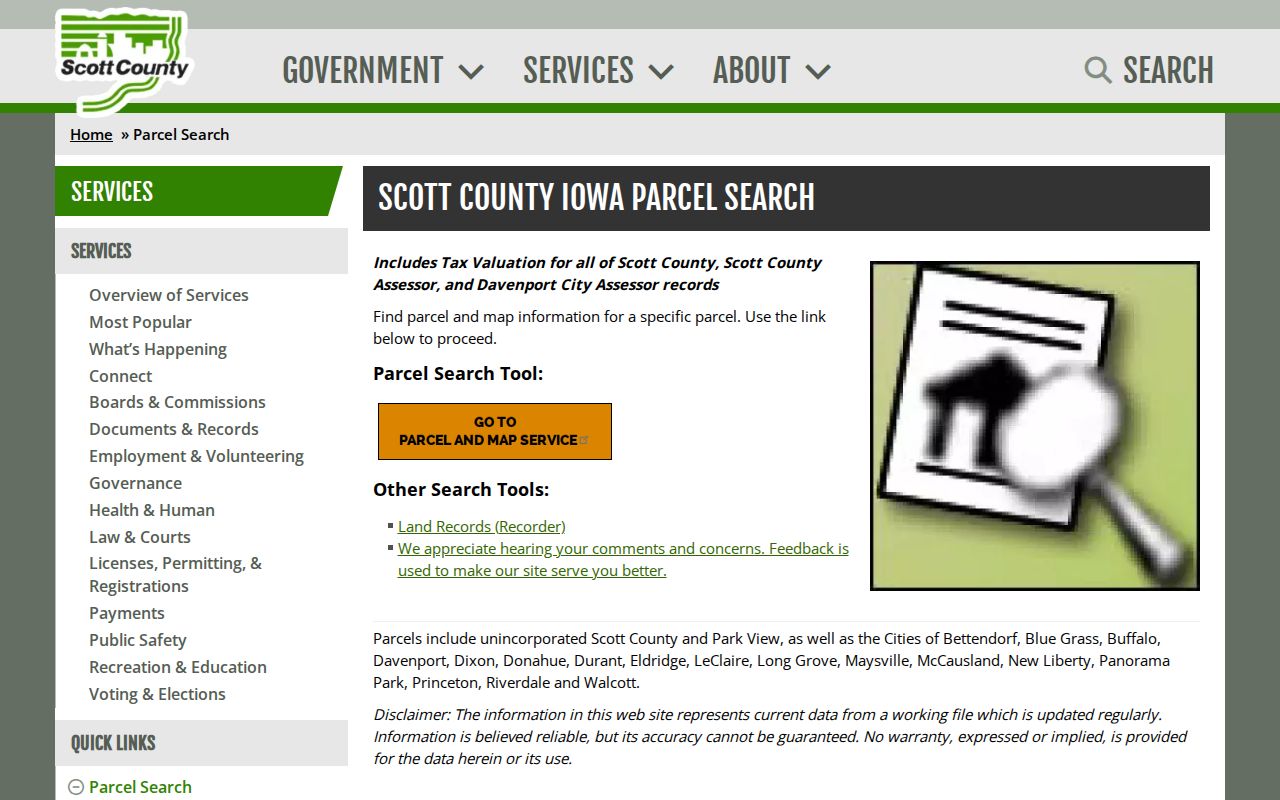
The county entry screen is the official route into parcel context, but occupancy still needs another source.
Davenport Names in Recorded Land Files
The Scott County Recorder keeps deeds, mortgages, plats, liens, releases, and other recorded instruments. AVA searches indexed documents and can connect a name with a parcel or legal transaction. Grantor means the party giving or releasing an interest. Grantee means the party receiving it. An index is a finding aid; the recorded image or certified copy is the fuller source.
AVA has an important delay. A document may already have an official number while it waits for indexing, verification, or public release. An empty result therefore does not always mean that no filing exists. Save the search terms, check again, or ask the Recorder with the document number and recording date.
| Party search | Grantor, grantee, and other indexed names |
|---|---|
| Document type | Deed, mortgage, lien, release, plat, and other categories |
| Recording facts | Date, instrument number, book/page where used |
| Parcel or legal link | Property context when indexed |
| Image status | Availability varies; official copy comes from the Recorder |
The free index is strong for finding the instrument. Use the office for an official copy and for documents that are recorded but not yet released online.
Davenport Permits Reveal Building Change
The city's building-permit viewer links property and project history. Search and detail fields can expose an address, parcel, owner or mailing name, contractor, project type, estimated cost, permit status, and inspection events. Current and historical access divides at March 1, 2020 in the city's guidance. Older City Archives permit microfilm at the library covers about 1923–1970.
A permit identifies people or entities tied to a project, not every occupant. Match its parcel ID with the county card and its legal owner with AVA. For a vanished building, compare permits with newspapers and Sanborn maps. The emergency-demolition detail for 324 Main Street is a local example of why an address can persist even when the structure does not.
Davenport Court Name Searches
Iowa Courts Online provides public docket information. Search fields include last or firm name, first and middle names, aliases, party role, county, case type, date of birth, case ID, and citation. Help material describes public trial cases after 1998 and notes that a new case may take one business day to appear. Juvenile, sealed, and confidential matters stay out of ordinary public results.
A result can show case ID, type, title, filing date, status, public party roles, attorneys, docket events, disposition, and payment fields when applicable. The free web index does not promise every filing image. Public courthouse terminals and the Clerk counter may provide more material, while subscriber document access follows separate terms.
The Iowa Courts helpdesk is 1-800-831-1396, Monday through Friday, 7:00 a.m. to 5:00 p.m. Use a case ID when asking for a specific file. Federal cases use the Southern District of Iowa and PACER, not the state portal.
Davenport Voter Lookup and Geography
The Iowa voter lookup checks an individual's registration through personal and address fields. It is not an open list of every name in a ZIP or precinct. Scott County Elections also publishes ward, precinct, polling, registration, and election information. As of August 4, 2026, its displayed county total was 123,522 registered voters. That number is a dated snapshot, not a current resident count.
A March 5, 2026 Iowa SOS directive asks auditors to distinguish residential addresses from commercial mailing addresses. That distinction echoes the property search: where mail goes is not always where a person resides. Safe at Home and other confidentiality protections can limit address disclosure. Use voter data only for authorized civic and personal purposes.
See the Scott County Elections portal.
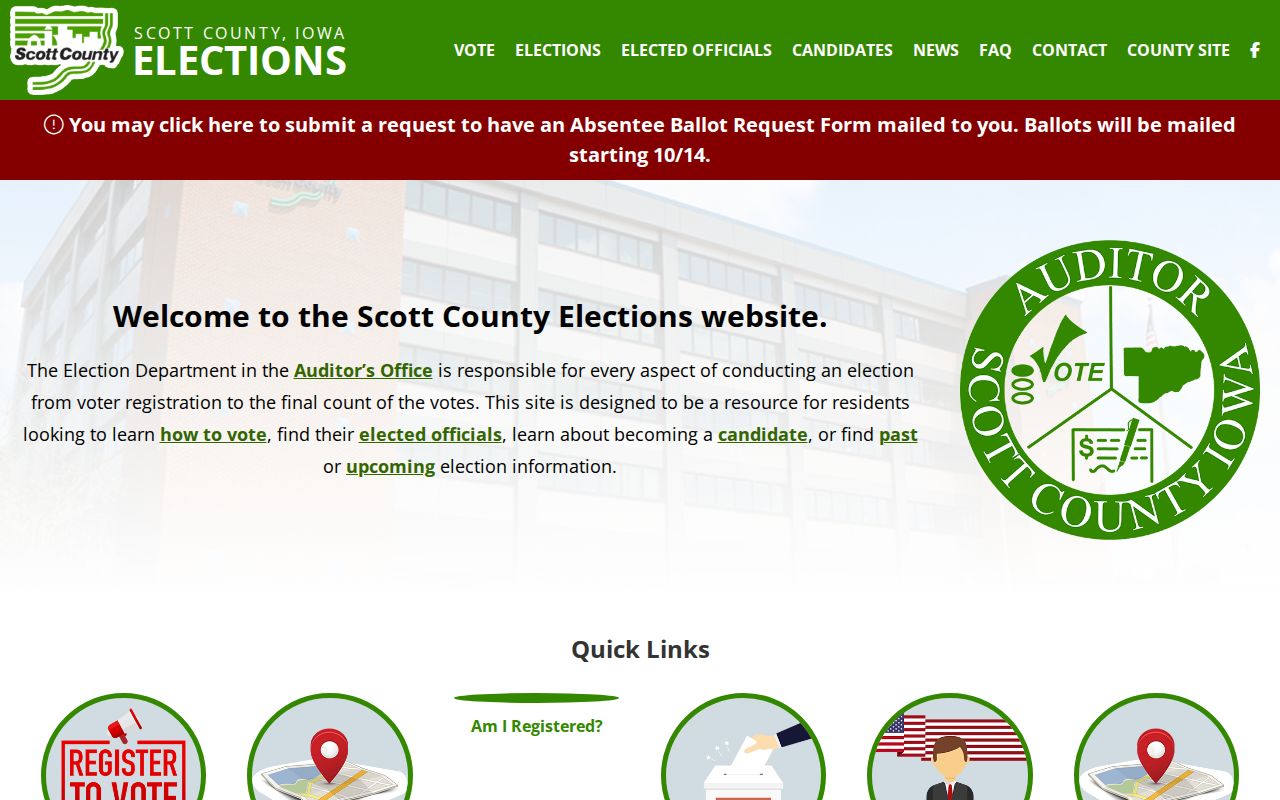
The elections screen gives direct access to current office notices and geographic tools, which should be dated when cited.
Davenport Vital Record Custody
Scott County Recorder and Iowa HHS share routes for birth, death, and marriage records. Their public charts use different cutoff language, so ask which office holds the specific event before paying. The local chart begins its current Recorder ranges in 1942. HHS provides statewide and genealogical routes plus special handling for adoption, delayed birth, and name-change records.
Effective July 1, 2026, the local and state pages show $20 for a certified copy or applicable search. A mailed request needs the current form, identity and entitlement facts, a notarized signature, and a government-ID copy. The Recorder accepts requests at 600 West 4th Street and offers help at 563-326-8650. Vital records are not a public resident roll.
Iowa Code section 144.43 opens qualifying birth, marriage, and divorce records after 75 years and death records after 50 years, subject to exceptions. Preserve the source's exact custody and eligibility terms.
Historical Davenport Resident Directories
Richardson-Sloane Special Collections at the Main Library holds the city's strongest historical directory shelf. One library page dates complete Davenport runs from 1855, while the house guide says 1856. Starting in 1890–91, a special heads-of-households and businesses section allows an address-first search. The library also holds newspapers, maps, permits, church films, county series, photographs, and obituary aids.
A directory can show a printed name, spouse, trade, business, address, and owner or boarding notation. It can lag a move or omit someone. Track the same name through several volumes and pair the result with a released census, deed, church entry, cemetery record, or original newspaper. The full shelf and entry method appear in the Davenport city directory.
Davenport Cemeteries and Local Archives
Oakdale Memorial Gardens was established in 1856. FamilySearch's historical Oakdale collection covers 1856–1989 and reports 23,867 records in 990 images, including a 1906 lot-owner volume. Scott County Library's separate index covers 39 rural cemeteries and burial sites through exact transcriptions made by Davenport women in the 1970s and 1980s.
Church films at the library include records from St. Anthony Catholic, St. Joseph Catholic, Grandview Baptist, Zion Lutheran, First Presbyterian, and other congregations. A burial or church entry may connect a name to relatives, witnesses, a former address, or a newspaper notice. Current interment questions may require a cemetery-office call because no full public current roster was found.
The Iowa State Historical Society finding aid adds recorder, clerk, probate, tax, map, cemetery, and municipal series. Renovation affects research access through late 2026, so contact the center in advance.
Davenport ZIP Codes Need Verification
Davenport-associated codes run from 52801 through 52809 in USPS and Iowa materials, but they are postal assignments. They do not equal city limits, wards, or the neighborhood labels used by Davenport GIS. USPS groups 52801–52805 and 52808 with one last-line family, while 52806, 52807, and 52809 form another in the cited label list.
A 2008 Postal Bulletin says 52807 became the last line for 204 deliveries formerly using 52804. That change can explain a conflict in old records. It does not define the current polygon. Standardize each full address with USPS, then compare it with the city geocoder or county GIS.
Davenport Record Terms Made Clear
Public databases use short terms that can cause bad matches if left undefined.
- Roll
- A list kept for a defined public task, such as assessment or registration. It is not a full population list.
- Index
- A finding aid that points to an original document or case.
- Parcel
- A unit of land tracked by county systems, which may show an owner but not all occupants.
- Situs address
- The physical location of property, distinct from the owner's mailing address.
- Criss-cross directory
- A directory organized by street or phone number rather than only by surname.
- Certified copy
- An official copy issued by the custodian, often with a seal or certification.
Keep the record's date, role, and keeper beside every copied fact. That simple practice prevents an index entry from being mistaken for the original.
What Davenport Records Cannot Prove
Property files identify owners and mailing contacts, not all residents. Postal results route mail. Court entries identify case parties. Voter tools answer registration questions under their own rules. A city directory can be out of date. Protected addresses, sealed cases, juvenile material, adoption files, and sensitive identifiers may be withheld by law.
| Official record strength | Common limit | Better confirmation |
|---|---|---|
| Named custodian and defined purpose | Only covers that office's record set | Match with a second official or original source |
| Dated fields and document numbers | Portal refresh can lag | Ask the custodian or obtain the filed image |
| Clear party or owner role | Role does not equal current residence | Compare site, mailing, event, and time |
| Historical volume citation | Spelling and address may change | Use nearby years, maps, and newspapers |
Davenport Record Changes to Watch
Several local facts are time-sensitive. Iowa's vital-copy fee changed to $20 on July 1, 2026. The voter-address directive dates to March 2026. Scott County published a data-privacy incident notice in February 2025. State Historical Society storage renovation affects access through late 2026. Portal fields, office hours, fees, and database totals should always carry a search date.
Davenport's longer history also warns against projecting current systems backward. Scott County's first district court met at St. Anthony's Church in 1838, the Recorder office began in the territorial period, and the first courthouse followed in 1840–41. Digital parcel, deed, court, and permit portals came much later. Library and archive sources bridge those gaps.
When no online record appears, search name variants and nearby dates, identify the custodian, try the counter or phone route, inspect archival finding aids, and use an Iowa Code Chapter 22 request for an eligible public administrative record. Report “not located” with the date and coverage limit instead of claiming the record does not exist.