
Davenport Directory Runs and Access
Davenport Public Library is the main local keeper of historical directories. Richardson-Sloane Special Collections describes complete Davenport city directories from 1855 to the present, while the library's house-research guide gives 1856 as the starting year. Keep that one-year difference in the notes. Confirm the exact volume in the catalog before treating either date as proof that a specific issue survives.
| Collection | Years or range | Where held | Access route |
|---|---|---|---|
| Davenport city directories | 1855 or 1856 to present | Richardson-Sloane | Reading room and catalog |
| FamilySearch directory reels | 1873–1899, with gaps | FamilySearch catalog | Digital or affiliate-library access |
| Polk directories | 1956, 1961, 1962, 1964–1976 with gaps | Library and society list | Catalog confirmation |
| Local newspapers | At least one title from 1838 onward | Davenport Public Library | Index, microfilm, or page request |
| City Archives permits | About 1923–1970 | Davenport City Archives | Research-room microfilm |
The filmed run includes cataloged reels for 1873–1878, 1880–1888, 1890–1899, and overlapping issues. A Power directory is cataloged for 1863, and a 1900 volume is described as 304 pages. These routes help when one shelf or account lacks the needed year.
Davenport's Directory Reading Room
Richardson-Sloane Special Collections occupies the second floor of the Main Library at 321 Main Street. Hours listed are Monday noon to 8:00 p.m., Tuesday through Friday 9:00 a.m. to 5:30 p.m., and the first Saturday 9:00 a.m. to noon. Call 563-326-7902 before a long trip.
The room holds roughly 22,000 volumes, more than 1,700 Scott County Iowa Genealogical Society titles, maps, newspapers, church films, and city archives. Researchers use pencils only. Lockers are available, and food and drink stay outside. As a FamilySearch Affiliate Library, it may also provide on-site access to images restricted at home.
Review the Special Collections holdings before visiting.

The captured page shows how a directory result can lead into city, county, church, newspaper, and map series.
Reading Davenport Directory Entries
Old directory lines compress several facts into a few words. Read the key printed in that volume before expanding a mark. Publishers changed their conventions. Copy the entry as printed first, then add an interpretation in separate notes.
| Printed name | Surname and given name, often for a head of household |
|---|---|
| Relationship | A spouse or household tie where printed |
| Work or affiliation | An abbreviated occupation, firm, or civic group |
| Street address | House number and street in that directory year |
| Status mark | Owner, boarder, widow, removed, or business notation |
| Source details | Year, publisher, page, section, and holding institution |
A “removed” note can point to a move but does not prove where the person went. A widow notation can guide an obituary search, though it is not a death record. Ads, maps, churches, and cemetery notes may supply more context.
- Criss-cross directory
- A format organized by street or phone number for an address-first search.
- Householder index
- A list centered on the recorded head of a household, not a full resident count.
- Abbreviation key
- The publisher's legend for shortened words and symbols.
- Index abstraction
- A shortened reference copied from an original page.
Davenport Directories Turn Address-First
The 1890–91 run marks a major shift. The house-research guide says directories from that point include a heads-of-households and business section organized by street address. A researcher can start with a building, find the printed household or firm, and return to the alphabetical section for more detail.
This reverse method helps when a surname is unknown or its spelling changed. It can also show nearby households on the same block. The Davenport street directory explains present-day address sources, while the old volumes preserve the historical street view.
Trace Davenport Families by Year
A sound family search follows names and places. One entry may be stale, misspelled, or absent because a person was not listed. Several nearby volumes show whether a fact repeats and when a change first appears.
- Begin with the nearest known surname or exact address in a confirmed volume.
- Copy the full line, abbreviations, page, section, and year.
- Check at least three volumes in both directions, noting moves and name changes.
- Compare the alphabetical listing with the street section after 1890–91.
- Pair released census years with nearby directories, then check deeds or newspapers.
- Keep uncertainty visible when two sources disagree.
The latest generally public federal census is 1950 under the 72-year release rule. City directories help fill years between census snapshots. Neither source alone proves continuous residence.
Digital Davenport Name Collections
Davenport Public Library's digital resources widen a search beyond alphabetical volumes. The African-American Business and Professional Women in Davenport index covers 1890–1920 and draws from directories, newspapers, and the Iowa Bystander. The Clarissa Cook ledger, a 1900 shooting-association resource, and scrapbook runs may reveal affiliations and name variants.
Open the digital resources list for current routes.
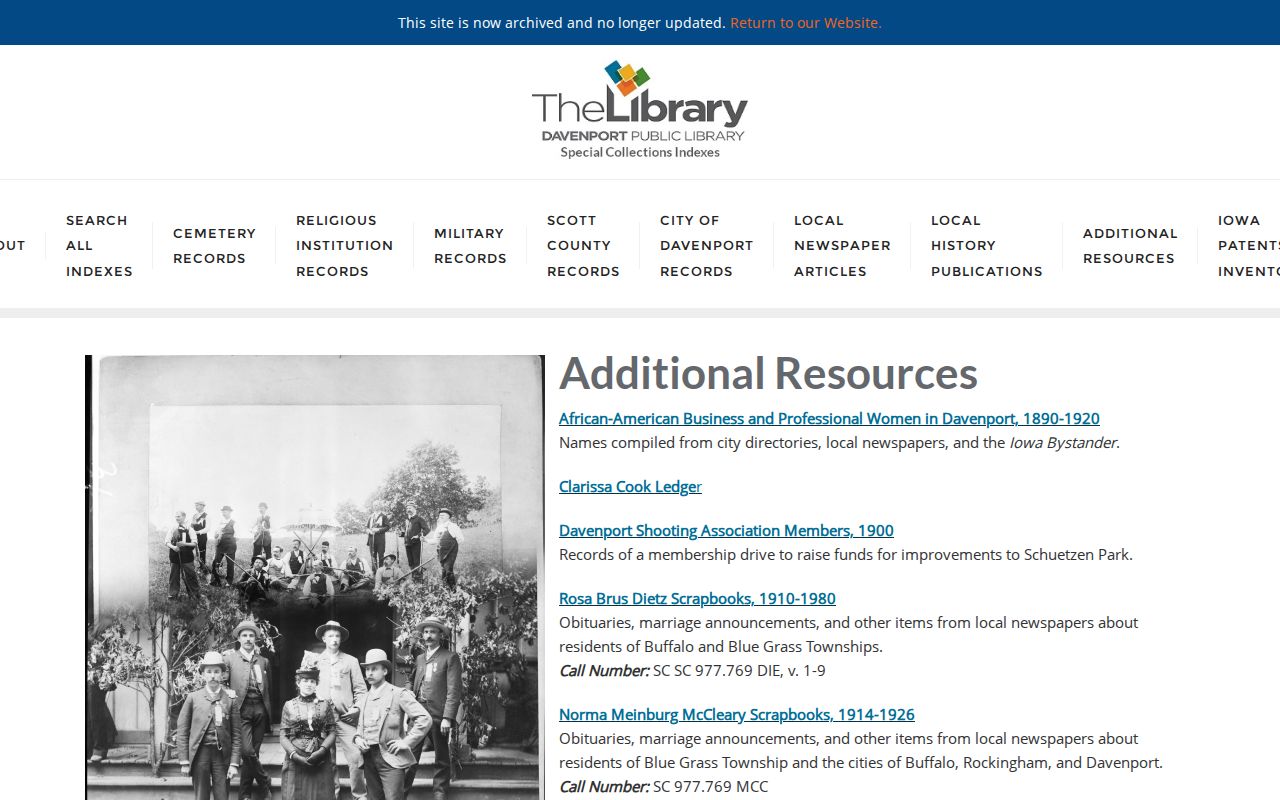
The list helps recover people scattered across print sources. Treat any index result as a pointer and inspect its cited page.
Davenport Newspapers Fill Directory Gaps
Newspapers can explain why a name appears, changes, or vanishes. The library reports at least one local title from 1838 to the present. Named holdings include The Gazette, Davenport Democrat and Leader, Davenport Daily Times, and Quad-City Times. German-language coverage runs roughly 1860–1918, with gaps.
The card file covers about 1950–1991 with gaps. Other aids include abstracted names from 1896–1946, obituary books for later ranges, and a death index for 2005–2016. Results may show title, author, paper, date, section, page, notes, abstract, and subjects. Those fields make a precise page request possible.
A marriage notice can identify a spouse or church. An estate notice may point to probate. Because an index may shorten a name, compare it with the original page.
Davenport Maps Support Directory Research
Davenport City Archives holds maps, plats, atlases, permit microfilm from about 1923–1970, and Sanborn maps for 1886, 1892, 1910, and 1956. Very few pre-1900 city maps survive in the described holdings, so an early street may require a plat, legal description, or newspaper reference.
Church materials cover named Davenport congregations including St. Anthony Catholic, St. Joseph Catholic, Grandview Baptist, Trinity Episcopal/Lutheran, Zion Lutheran, First Presbyterian, and Unitarian records. Dates and rules vary. Ask library staff for a call number and restriction instead of assuming an online index exists.
Davenport City Directory Milestones
The print record grew beside city and county institutions. These dates show which source may exist for a period.
| Date | Local milestone |
|---|---|
| 1838 | The first Scott County district court met at St. Anthony's Church. |
| 1855–1856 | The directory run begins, with a one-year source difference. |
| 1863 | A directory published by Power is cataloged. |
| 1873–1899 | Eight filmed reels cover parts of this span. |
| 1890–1891 | A street-address section permits reverse searching. |
| 1900 | A city directory is identified as 304 pages. |
| 1956–1976 | Selected Polk issues survive with gaps. |
The first courthouse followed the 1838 court session in 1840–41. Today's library collections bridge that early civic record, the print era, and later city archives.
Davenport Archives Beyond Directories
The Iowa State Historical Society finding aid lists Scott County recorder, clerk, auditor, probate, court, tax, cemetery, and municipal series. Its Des Moines center lists Wednesday through Friday 9:00 a.m. to 4:30 p.m. and Saturday 9:00 a.m. to 3:00 p.m. Renovation affects access through late 2026, and five days' advance contact is requested.
Davenport Public Library remains the best first stop. No separate official Scott County, Iowa historical-society search portal was confirmed. Use the library, State Historical Society, FamilySearch, and documented genealogical-society holdings.
Consult the Davenport archives catalog for local series.
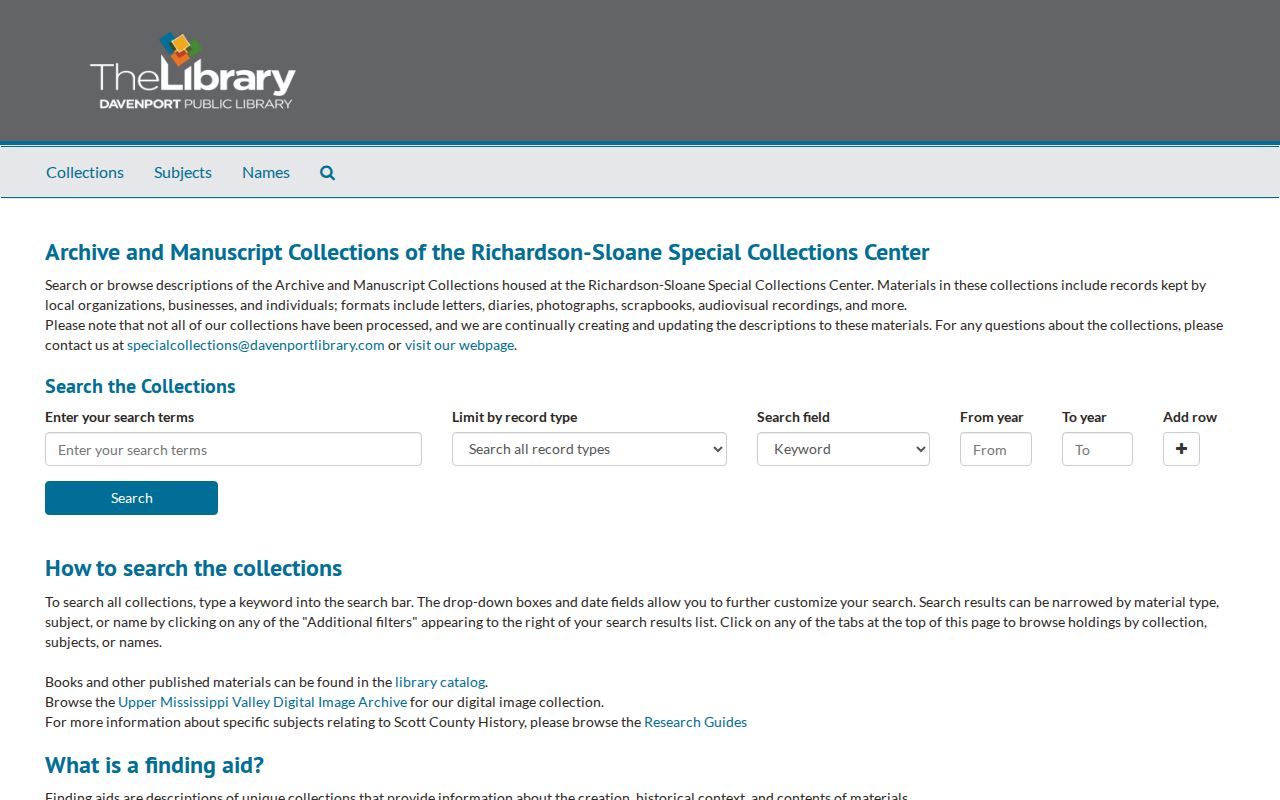
The catalog can turn a broad surname search into a collection title, date span, and clear staff request.
Confirm Davenport Directory Clues
A directory may lag a move, omit a person, repeat an old address, or print a business location. Absence does not prove that someone was absent from Davenport. Check spelling variants, initials, a spouse's name, the street section, nearby years, and newspapers before ending the search.
Preserve the original street form. Record whether the source is an original page, microfilm image, or abstraction. Confirm key findings with a deed, released census image, church entry, cemetery record, permit, probate file, or newspaper page. This keeps city directories useful without asking them to prove more than they contain.